What Credit Score Do You Need for an RV Loan in 2026?
 Mar, 1 2026
RV Loan Interest Calculator
Your Monthly Payment
Getting an RV loan isn’t like getting a car loan. Even if you’ve got decent credit, you might still hit a wall if your score isn’t where lenders expect. In 2026, the rules haven’t changed much from recent years-but knowing the exact numbers can save you months of stress and thousands in interest.
What’s the minimum credit score for an RV loan?
Most lenders in Australia want a credit score of at least 660 to approve an RV loan. That’s the bare minimum. If you’re below that, you’ll likely get denied outright or be pushed toward subprime lenders with sky-high rates.
But here’s the real story: the average approved borrower has a score between 700 and 750. That’s not a coincidence. Lenders see scores above 700 as low-risk. Below 700? You’re considered a stretch. And with RV loans often running $50,000 to $150,000, lenders don’t take chances.
Why do lenders care so much about your credit score?
RVs aren’t like houses. They depreciate fast. A $100,000 motorhome might be worth $60,000 in three years. That means if you default, the lender can’t just sell the RV and cover the loan. They lose money. So they need to be sure you’ll pay.
Your credit score tells them: have you paid bills on time? Have you carried too much debt? Have you opened too many new accounts lately? One missed payment on a credit card can drop your score by 50 points-and that’s enough to get you flagged.
Think of it this way: lenders aren’t just looking at your score. They’re looking at your history. A 680 score with five years of on-time payments is better than a 720 score with three late payments last year.
What if your credit score is below 660?
You’re not out of luck-but you’ll pay more. Some lenders specialize in bad-credit RV loans. They’ll approve you with a score as low as 580, but here’s what you’re signing up for:
- Interest rates between 12% and 20%
- Down payments of 20% or more
- Loan terms capped at 5 years (instead of 10-15)
- Higher monthly payments that eat into your camping budget
For example: a $75,000 RV at 15% interest over 7 years costs $1,180/month. At 8% interest (for someone with a 720 score), it’s $960/month. That’s $2,640 extra per year. That’s a lot of fuel, campsites, and groceries.
Some lenders also require a co-signer. That means someone else-usually a family member-has to guarantee the loan. If you default, they’re on the hook. It’s not just about money. It’s about trust.
How to improve your credit score fast
If you’re close to 660, you can boost your score in 60-90 days. Here’s what works:
- Pay down credit card balances-aim for under 30% of your limit. If you’ve got $10,000 in credit, keep your balance under $3,000.
- Don’t open new accounts-every hard inquiry drops your score by 5-10 points. Wait until after you’re approved.
- Check for errors-one in five Australians has a mistake on their credit report. Dispute it with Equifax or Illion. A simple fix can add 30-50 points.
- Make all payments on time-even one late payment can undo months of progress.
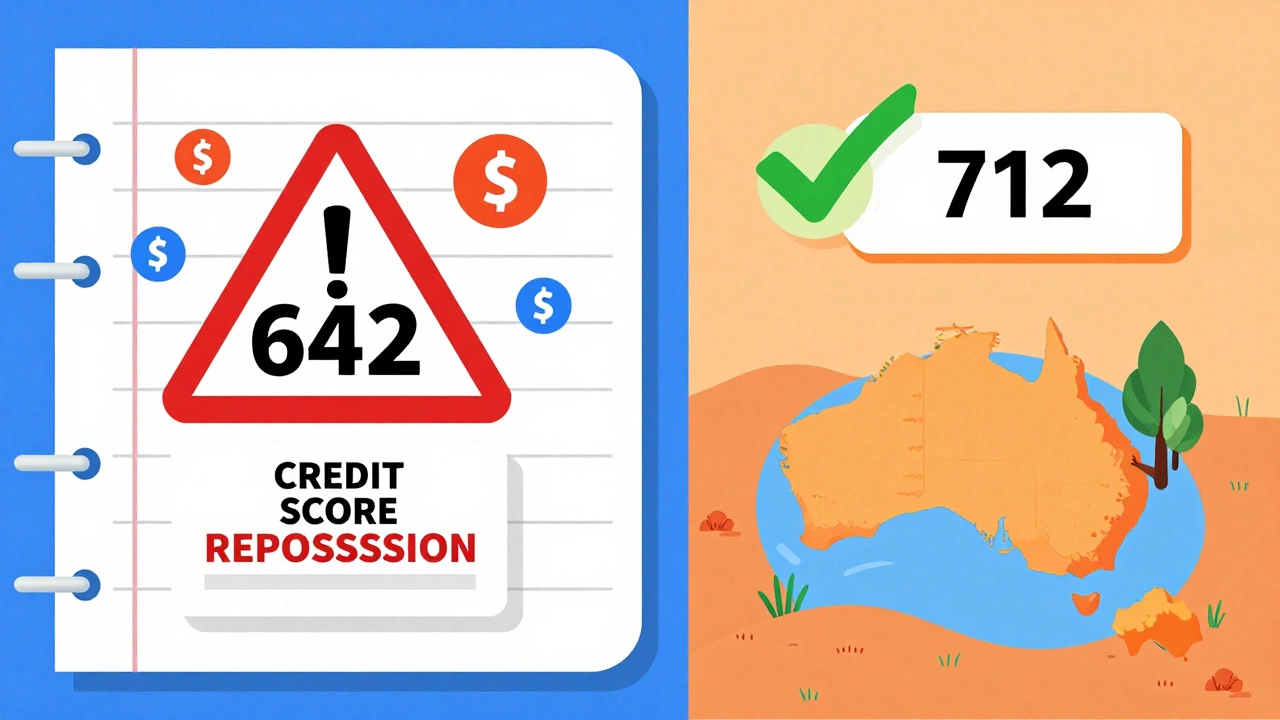
Some people see results in as little as 30 days if they focus on high-utilization cards. One client in Perth raised their score from 642 to 708 in 45 days by paying down two cards and disputing an old collections error.
What lenders look at besides your score
Your credit score isn’t the whole story. Lenders also check:
- Debt-to-income ratio (DTI)-your monthly debt payments divided by your gross income. Keep it under 40%. If you earn $70,000 a year and owe $2,500/month in loans, your DTI is 43%. That’s too high.
- Stable income-lenders want proof you’ve been employed for at least two years. Self-employed? You’ll need two years of tax returns.
- Down payment-putting down 20% or more can make up for a lower score. It shows you’re serious.
- Loan term-longer terms (10-15 years) lower monthly payments but cost more in interest. Shorter terms (5-7 years) are harder to qualify for but save money.
One lender in Adelaide told me they’ll approve someone with a 670 score if they put down 25% and have a DTI of 32%. That’s the sweet spot.
Where to apply for an RV loan
Not all lenders are the same. Here’s where to look:
- Specialty RV lenders-companies like RV Lending Australia or Motorhome Finance Direct focus only on RVs. They know the market.
- Credit unions-they often have lower rates and more flexibility than big banks. If you’re a member, ask.
- Dealership financing-convenient, but watch out. They sometimes mark up rates by 2-4%.
- Big banks-ANZ, NAB, Westpac, and Commonwealth Bank offer RV loans, but they’re strict. You’ll need a score above 700.
Don’t just go with the first offer. Get at least three quotes. A 1% difference in interest on a $80,000 loan over 10 years saves you over $4,000.

What to avoid
Don’t fall for these traps:
- “Guaranteed approval” ads-they’re usually scams or subprime lenders with hidden fees.
- Buying a used RV with no inspection-a $200 inspection can save you $10,000 in repairs.
- Stretching your loan term too long-you’ll end up paying more than the RV is worth.
- Applying to multiple lenders at once-each hard inquiry drops your score. Space them out over 30 days.
Real-world example
Sarah, 42, from Bunbury, wanted a $90,000 motorhome. Her score was 658. She was denied by two banks. She paid down her credit card from $4,200 to $1,800, disputed a 5-year-old collections error, and waited 60 days. Her score jumped to 712. She got approved for a 9-year loan at 7.9% with a 15% down payment. Her monthly payment? $920. She’s been camping every weekend since.
Can I get an RV loan with a 600 credit score?
Yes, but it’s expensive. Lenders that work with subprime borrowers may approve you, but expect interest rates between 14% and 19%, a down payment of 20% or more, and a loan term of 5 years or less. You’ll pay thousands more in interest than someone with a 700+ score. It’s possible, but not smart unless you have no other options.
Does the type of RV affect the credit score needed?
Yes. Class A motorhomes (the big ones) are riskier for lenders because they cost more and depreciate faster. You’ll need a higher score-usually 700+-to get approved for one. Class C or travel trailers are easier to finance. You might get approved with a 660 score if you’re putting down 20% or more. Smaller RVs = less risk = more flexibility.
How long does an RV loan application take?
If you have all your documents ready-proof of income, ID, credit report, down payment-it usually takes 3-7 business days. Specialty lenders can approve you in 48 hours. Big banks take longer, especially if they need to order a property appraisal. Plan ahead. Don’t wait until the weekend you want to pick up the RV.
Can I use a personal loan for an RV instead?
Technically yes, but it’s not recommended. Personal loans have higher interest rates (10-20%) and shorter terms (3-5 years). RV loans are secured by the vehicle, so they have lower rates. A personal loan also doesn’t offer the same flexibility-like longer terms or seasonal payment plans. Stick with an RV-specific loan if you can.
What happens if I can’t make a payment?
If you miss one payment, you’ll get a late fee and a ding on your credit report. Miss two or more, and the lender can repossess the RV. Unlike a car, RV repossession is messy-they have to tow a 30-foot motorhome. Lenders usually try to work with you first. Call them before you miss a payment. Many offer deferment or payment plans if you explain your situation.
Final advice
Don’t rush. The best RV loan isn’t the one you get fastest-it’s the one that fits your budget for the long term. A score of 700+ gives you options. Below 660? Focus on fixing your credit before you start shopping. It’s not about waiting. It’s about being ready.
And remember: the RV isn’t the goal. The freedom, the trips, the quiet mornings by the lake-that’s what you’re buying. Don’t let a bad loan steal that.