Do You Need a Special TV for an RV?
 Mar, 19 2026
RV TV Power Calculator
When you’re on the road in your motorhome, watching your favorite show or catching the news feels like a small luxury. But here’s the real question: do you actually need a special TV for an RV? The answer isn’t as simple as yes or no. It depends on your power setup, where you park, and how much you care about picture quality. Most people assume they can just bring their home TV along - and that’s where things go wrong.
Why Home TVs Don’t Work Well in RVs
A standard 55-inch smart TV from your living room might look great on the couch, but it’s a disaster on the road. These TVs are designed for 120V AC power, which means they need to be plugged into a wall outlet. In an RV, that usually means running a generator or staying at a campsite with hookups. But what if you’re boondocking - no hookups, no generator noise, just quiet and stars?
Most home TVs draw 100 to 200 watts. That’s a lot for a 12V battery system. A typical deep-cycle RV battery holds about 100 amp-hours. Running a 150-watt TV for just two hours? That’s 12.5 amps. You’re draining nearly 13% of your battery in one evening. Add in a fridge, lights, and a water pump, and you’re dead before sunrise.
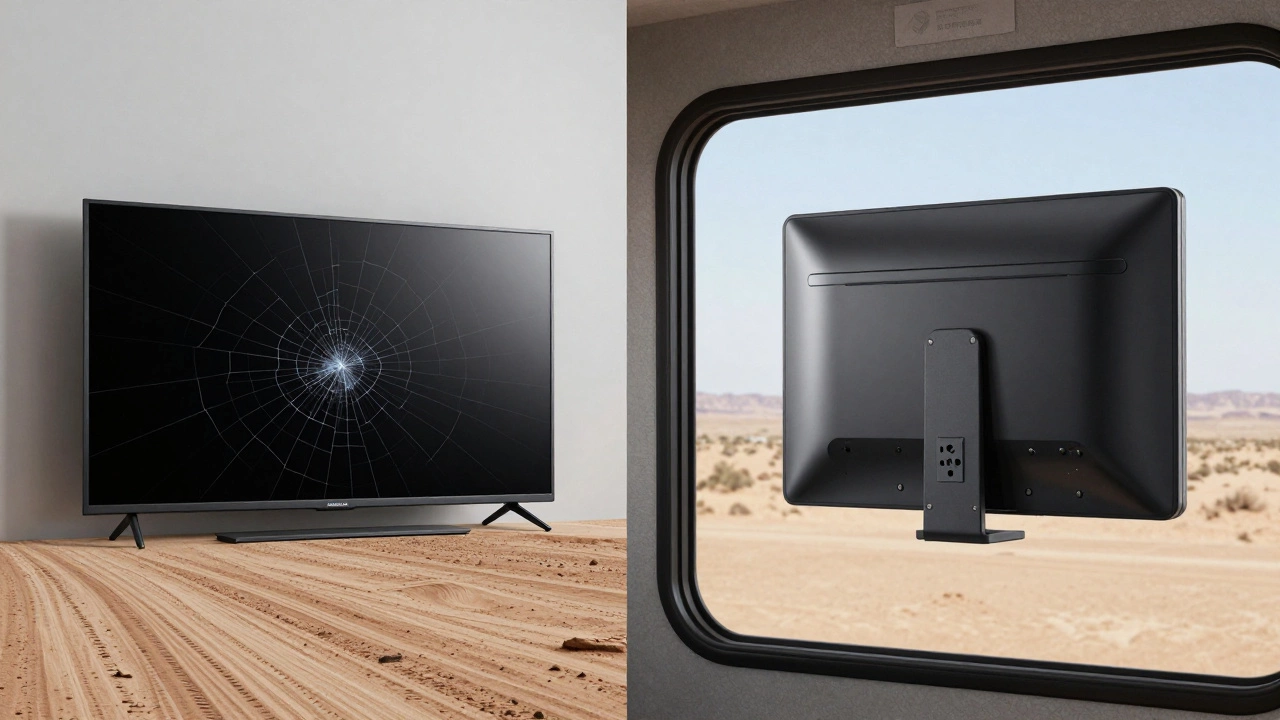
Then there’s the physical problem. RVs bounce. They shake on gravel roads. They sway in wind. A heavy, fragile glass screen isn’t built for that. I’ve seen TVs crack from a bumpy stretch of dirt road. Not fun.
What Makes an RV TV Different?
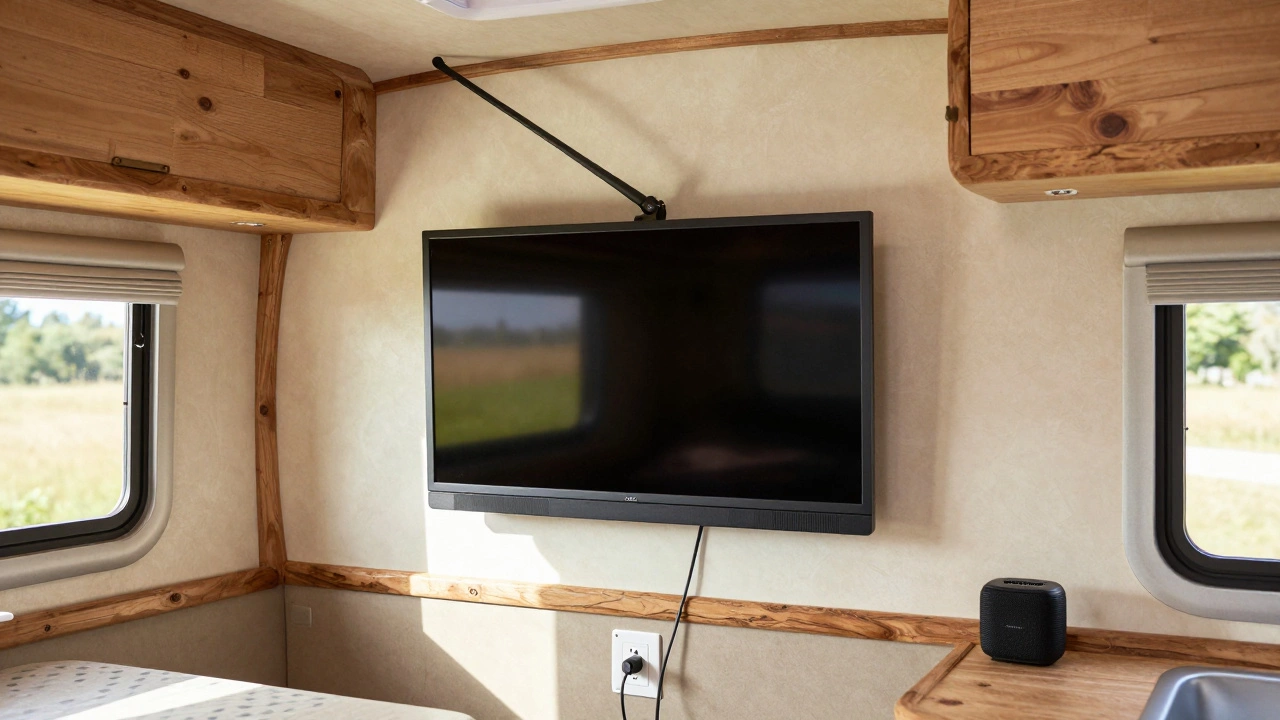
RV-specific TVs are built for three things: low power, durability, and 12V compatibility. They’re not fancy. They don’t have 8K resolution or Dolby Vision. But they do what you need: they turn on, they show the picture, and they don’t kill your battery.
Most RV TVs run on 12V DC power - the same power your fridge and lights use. That means you can plug them directly into your RV’s cigarette lighter socket or a 12V outlet. No inverter needed. No extra wiring. No generator. Just plug and play.
They’re also lighter. A 32-inch RV TV weighs about 8 pounds. A similar home TV? Over 30 pounds. That’s a huge difference when you’re mounting it on a wall that moves with every bump. Many RV TVs have reinforced frames, shock-absorbing mounts, and screens treated to handle glare from sunlight.
And here’s the kicker: they’re designed for digital TV signals. In remote areas, over-the-air broadcasts are often your only option. RV TVs come with built-in ATSC 3.0 tuners - the latest standard for free broadcast TV in the U.S. and Canada. No antenna box. No streaming apps. Just point the antenna, tune in, and watch.
Do You Need an Antenna?
If you’re relying on over-the-air TV, yes - you need an antenna. But not just any antenna. A standard indoor home antenna won’t cut it. You need something designed for moving vehicles.
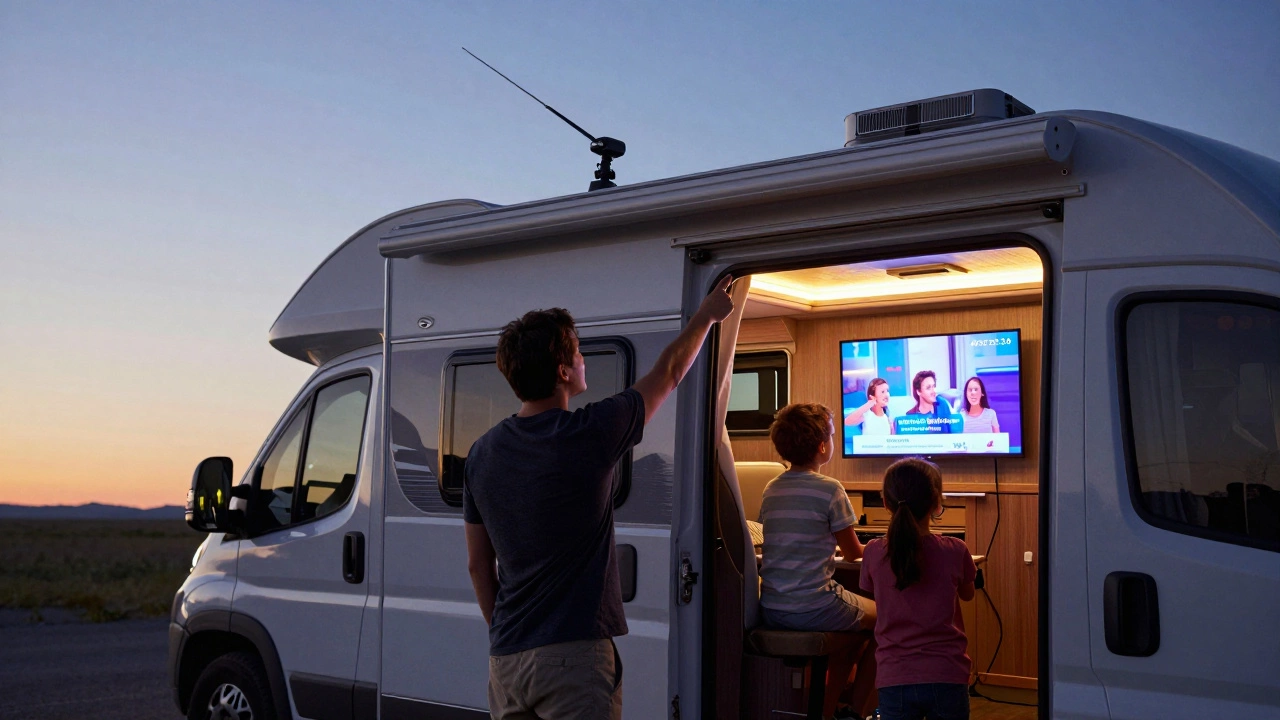
Most RV owners use a roof-mounted antenna like the Winegard Rayzar Air or the Channel Master Smartenna. These are motorized, auto-scan, and can find signals from 50 miles away. They’re expensive - around $300 - but they work. I’ve watched ESPN in the middle of the Mojave Desert because of one.
Some newer RV TVs come with a built-in antenna. These are great for short trips near towns, but if you’re heading into national parks or mountain ranges, you’ll still need a stronger external one.
Streaming? Don’t Count on It
Let’s be honest: streaming Netflix or YouTube in your RV sounds nice. But unless you’re parked at a full-hookup site with reliable Wi-Fi, it’s not practical. Cellular data is spotty. Even 5G drops out in canyons and forests. And streaming one hour of HD video uses 3GB. That’s a lot of data for a mobile plan.
Some people try to use tablets or laptops. But those screens are too small. You want something big enough to watch with your family. That’s why most RVers stick with broadcast TV. It’s free, it’s reliable, and it doesn’t use data.
If you insist on streaming, get a Roku or Fire Stick. But only if you have a stable Wi-Fi connection - like at a paid campground with good internet. Don’t rely on it for daily use.
Size Matters - But Not Like You Think
Most RVs have small TV spaces. A 32-inch screen is the sweet spot. It’s big enough to enjoy, small enough to fit above the dinette or in the bedroom. Anything bigger than 40 inches is usually overkill - and heavier than your mount can handle.
Look for TVs with a VESA mount pattern of 75x75 or 100x100. That’s the standard for RV mounts. Check the weight limit on your wall bracket. Most RV wall mounts are rated for 25 pounds. Don’t push it.
Top 3 RV TVs You Can Actually Buy Right Now
- VIZIO V-Series 32" (V325-H19) - Runs on 12V, built-in ATSC 3.0 tuner, weighs 9.5 lbs, under $200. Best for budget buyers.
- Samsung 32" RV TV (UA32T5300AW) - Brighter screen, better color, 12V compatible, comes with remote. Good for sunlit parking spots.
- Entertainment One 32" RV TV - Built-in Bluetooth, HDMI, USB, and 12V input. Most versatile. Best for those who want to connect game consoles or play movies from a USB drive.
All three are available at RV supply stores and Amazon. None require a power inverter. All work with standard RV antennas.
What If You Already Have a Home TV?
You can make it work - but only if you have a power inverter and a solid battery system. A 1000-watt pure sine wave inverter will let you run a 150-watt TV. But you’ll drain your batteries fast. You’ll need at least two 100Ah lithium batteries to make it last more than 3 hours.
And you’ll still have the vibration issue. Mounting a heavy TV on a moving wall? You’ll need a heavy-duty, shock-absorbing mount. Those cost $150+. Add in the inverter ($250), the batteries ($800), and the mounting hardware - you’re over $1,200 just to watch TV.
Is it worth it? Probably not. You’re better off spending $250 on a proper RV TV and calling it a day.
Final Verdict
You don’t need a special TV for an RV - but you really should get one. A regular TV isn’t dangerous. But it’s inefficient, fragile, and frustrating. RV-specific TVs are cheaper in the long run, easier to install, and built for the life on the road. They’re not flashy. But they do their job without drama.
If you’re renting a motorhome, most rental companies already have a TV installed. Just ask. If you own your rig, skip the home TV. Go for a 32-inch 12V model with a built-in tuner. It’ll save you money, power, and stress.
And if you’re wondering about sound? A small Bluetooth speaker costs $40 and sounds better than the TV’s built-in speakers anyway. Pair it up. You’re welcome.
Can I use my home TV in my RV?
Yes, but it’s not practical. Home TVs need 120V AC power, which means you need an inverter and strong batteries. They’re heavy, fragile, and drain power fast. You’ll likely run out of battery by midnight. An RV-specific TV is cheaper, lighter, and more reliable.
Do RV TVs need an antenna?
If you want free over-the-air channels, yes. A roof-mounted RV antenna like the Winegard Rayzar Air is best. It picks up signals from far away and works while you’re moving. Built-in antennas on some TVs are okay for near-town use, but not for remote camping.
What size TV is best for an RV?
A 32-inch TV is the sweet spot. It’s large enough to enjoy, small enough to fit in most RV TV mounts, and light enough to not strain your wall. Anything over 40 inches is usually too heavy and takes up too much space.
Can I stream Netflix in my RV?
You can - but only if you have strong Wi-Fi or unlimited cellular data. Streaming uses a lot of data (3GB per hour). Most rural areas have poor signal. Over-the-air TV is more reliable and free. Use streaming only at campgrounds with good internet.
Do RV TVs work with Bluetooth speakers?
Yes, most modern RV TVs have Bluetooth. Pairing a small speaker improves sound quality dramatically. The built-in speakers on RV TVs are weak. A $40 Bluetooth speaker like the JBL Go 3 makes a big difference.