Can I Take an Axe Camping in the UK? Legal Rules & Safety Tips
 Oct, 15 2026
UK Axe Camping Legal Checker
Select your scenario to check the legal status of carrying and using an axe in the UK.
You’re packing your kit for a weekend of wild camping in the Scottish Highlands or perhaps a secluded spot in Wales. You’ve got your tent, your stove, and maybe some firewood you plan to gather yourself. But then you pause at the door, looking at that trusty hatchet leaning against the wall. Can you actually take an axe camping in the UK? The short answer is yes, but it’s not as simple as just throwing it in your backpack and heading out. There are specific laws about carrying bladed items, strict rules on where you can use them, and serious safety considerations most beginners overlook.
If you’ve ever wondered whether you’ll get fined for having a tool in your pack, or if you’re allowed to chop down a tree for fuel, this guide breaks it all down. We’ll look at what the law actually says, how to transport your axe legally, and when using one might be frowned upon by locals or landowners. It’s about balancing practicality with respect for the environment and other people.
Key Takeaways
- Legality: Owning an axe is legal, but carrying it in public requires "good reason." Camping counts, but you must prove it.
- Transport: Keep the blade sheathed and secure during transit to avoid accusations of aggressive possession.
- Usage: Only cut deadfall wood. Never damage living trees or protected vegetation.
- Location Matters: Scotland has different access rights compared to England and Wales regarding wild camping and resource use.
- Safety: Always wear eye protection and maintain a clear strike zone to prevent accidents.
The Legal Reality: Carrying Blades in Public
Let’s tackle the biggest worry first. In the UK, specifically under the Criminal Justice Act 1988, it is illegal to have an article with a blade or sharp point in a public place without good reason or lawful authority. This sounds scary, but don’t panic. An Axe is a cutting tool consisting of a head attached to a handle, used primarily for chopping wood. While it fits the definition of a bladed article, the law recognizes practical uses.
Camping is generally considered a "good reason" to carry an axe, provided you are actually going camping. If a police officer stops you on a high street in London with a full-size felling axe strapped to your back, they might question you. But if you’re walking up a trail towards a known wild camping area, wearing hiking boots and carrying a rucksack, the context supports your claim. The key is intent. You aren’t carrying it to threaten anyone; you’re carrying it to process firewood or prepare a campsite.
However, there is a nuance regarding the type of axe. A small folding saw or a compact hatchet is less likely to raise eyebrows than a massive double-bit logging axe. For most modern wild campers, a lightweight splitting maul or a bushcraft hatchet is sufficient. These tools are easier to justify because their size aligns with personal utility rather than heavy-duty forestry work.
Where Can You Actually Use It?
Owning the right to carry the tool doesn’t automatically grant you the right to swing it anywhere. This is where Land Access Rights become critical. In England and Wales, wild camping is technically only permitted on common land or with explicit permission from the landowner. Using an axe to cut wood adds another layer of complexity because you are altering the landscape.
In contrast, Scotland operates under the Land Reform (Scotland) Act 2003, which grants everyone the right to roam. This means you can camp almost anywhere, provided you follow the Scottish Outdoor Access Code. Even here, though, you cannot just start hacking away. The code emphasizes leaving no trace. Cutting green wood is discouraged unless necessary for survival, and even then, you should minimize impact.
| Region | Carrying Legality | Wood Cutting Rules | Best Practice |
|---|---|---|---|
| England & Wales | Legal with good reason (camping) | Strictly deadfall only; avoid damaging crops or livestock fences | Ask landowner permission if near farms |
| Scotland | Legal under Right to Roam | Deadfall preferred; limited green wood for immediate fire | Follow Scottish Outdoor Access Code strictly |
| National Parks | Check local bylaws | Often stricter; may prohibit cutting any wood | Bring pre-cut wood or use gas stoves |
Choosing the Right Tool for Wild Camping
Not all axes are created equal. If you’re trekking five miles into the wilderness, you don’t want a 4-pound steel head swinging around your hips. Weight and versatility matter. Most experienced wild campers opt for a Bushcraft Hatchet, which is a small, single-handed axe designed for carving, batoning, and light chopping. These typically weigh between 1 and 2 pounds and have handles short enough to fit inside a pack.
Why choose a hatchet over a full-size axe? First, portability. Second, control. When you’re tired after a long hike, swinging a heavy tool increases the risk of injury. A lighter tool encourages precision. Additionally, many modern bushcraft axes come with integrated features like hammerbacks or bottle openers, adding value to every gram you carry.
Consider the material too. Carbon steel holds an edge better but rusts easily if left wet. Stainless steel is lower maintenance but may require more frequent sharpening. For wet British climates, a coated carbon steel head or a well-maintained stainless option is often the smartest choice. Remember, a dull axe is a dangerous axe. Bring a small whetstone or diamond file to keep it keen.
Safety First: Avoiding Common Accidents
Accidents happen fast when metal meets wood. The most common injury isn’t from the wood flying off-it’s from user error. Here are three non-negotiable safety rules:
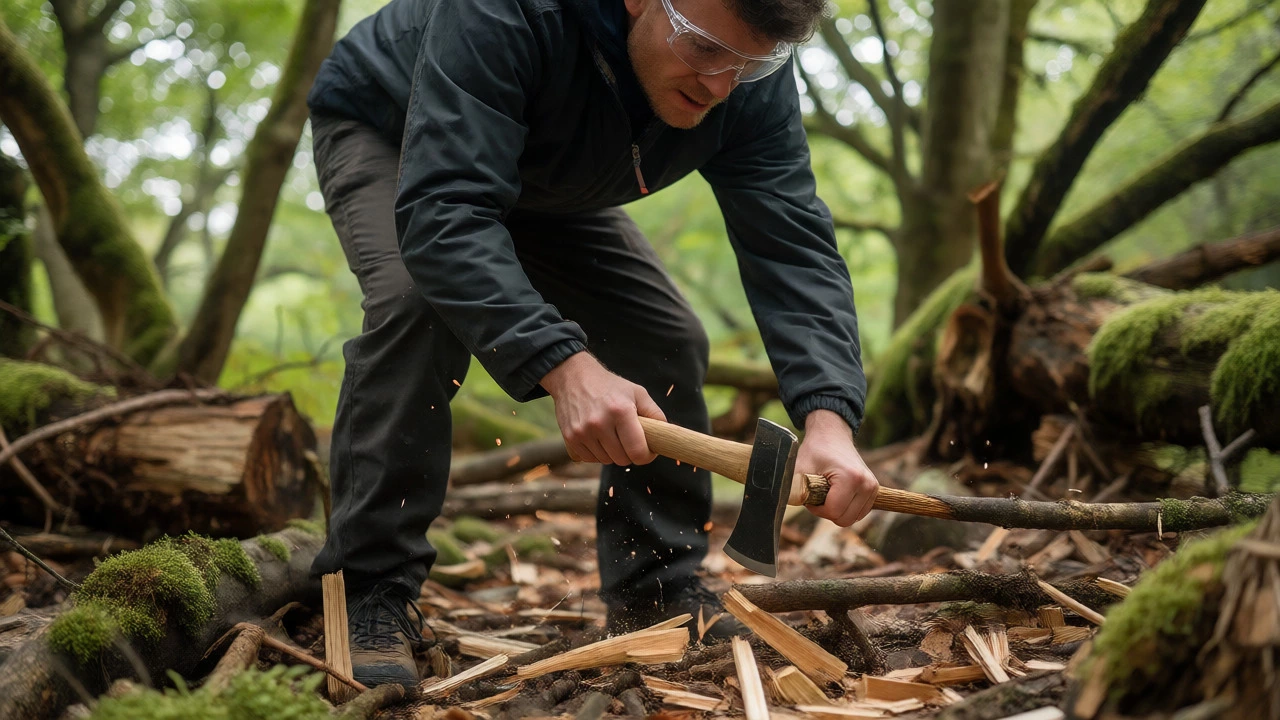
- Clear the Zone: Ensure no one is within a 360-degree radius of your swing path. At campsites, people drift. Make sure your partner isn’t standing behind you while you split kindling.
- Eye Protection: Wood chips fly unpredictably. Wearing safety glasses might feel uncool, but losing vision in one eye is worse. Many modern sunglasses offer adequate protection, but dedicated polycarbonate lenses are safer.
- Proper Grip and Stance: Stand with feet shoulder-width apart. Hold the handle firmly but not rigidly. Let the weight of the axe do the work; don’t force it. If you hit a knot and the axe bounces, step back and reassess.
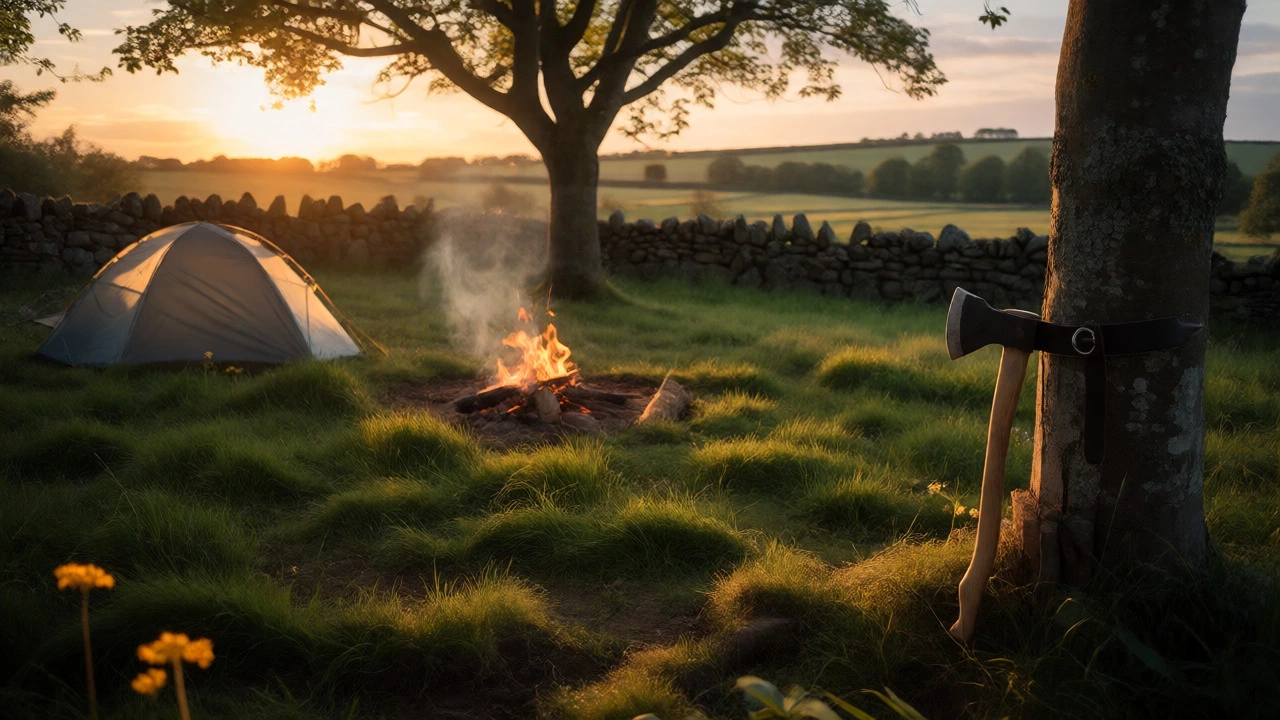
Also, never leave your axe stuck in a stump or log unattended. Tripping hazards are real, especially at night when visibility drops. Store it safely in its sheath or hang it securely on a tree branch out of walkways.
Ethical Considerations and Leave No Trace
Just because you can cut wood doesn’t mean you should. The Leave No Trace principle is central to modern wild camping ethics. It suggests minimizing human impact on natural environments. Chopping down live trees disrupts habitats and takes decades to recover. Deadfall-branches already on the ground-is abundant in most UK forests and provides ample fuel for small fires.
Using an axe on deadfall is generally acceptable. However, if you find yourself needing to cut branches from low-hanging limbs, ask yourself if it’s truly necessary. Are you building a shelter that will last years, or just cooking dinner? If it’s the latter, consider bringing a gas stove instead. It’s faster, cleaner, and leaves zero visual impact. Save the axe for emergencies or specific projects like building a temporary windbreak.
Furthermore, be mindful of wildlife. Birds nest in trees, and insects thrive in decaying logs. Don’t destroy micro-habitats unnecessarily. Respect the ecosystem you’re visiting. Locals and conservation officers appreciate campers who tread lightly. If you see signs prohibiting wood gathering, obey them regardless of national laws. Local management plans often override general rights due to specific ecological concerns.
Practical Tips for Transporting Your Axe
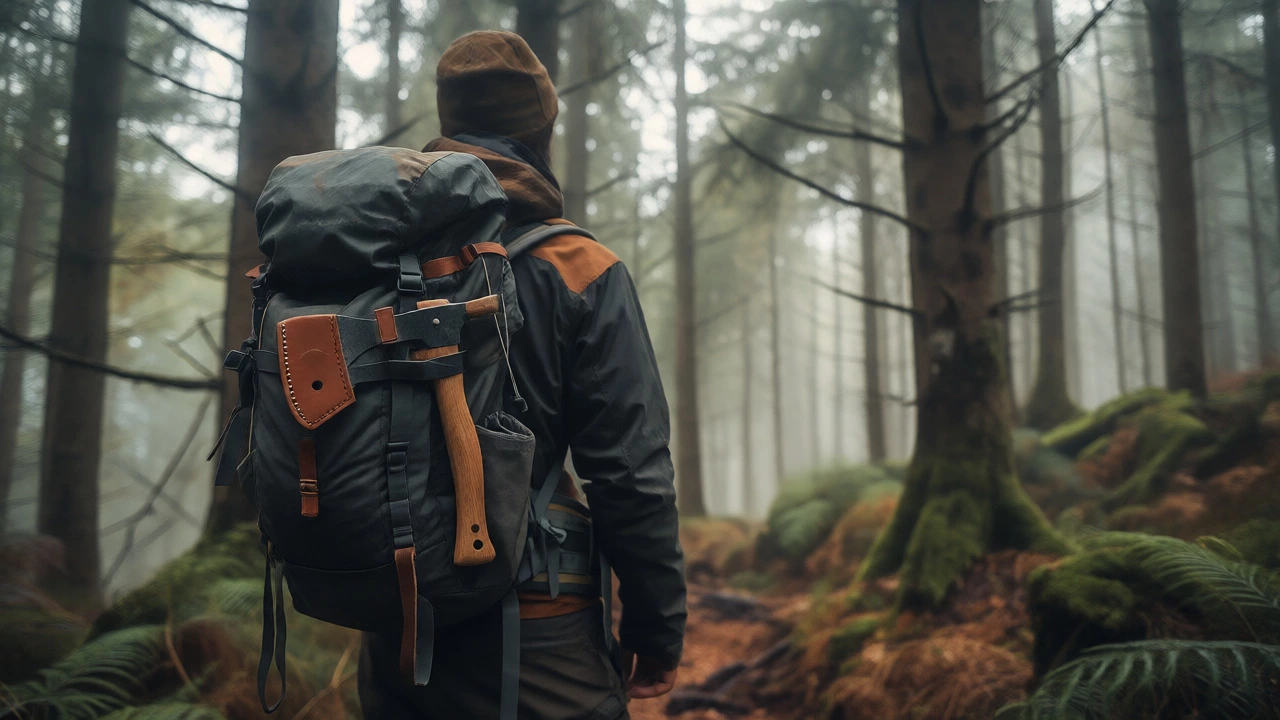
How you carry your axe affects both safety and legality. Throwing a loose axe head into a bag can ruin zippers and puncture tents. Always use a proper sheath. Leather or heavy-duty nylon covers protect the blade and prevent accidental cuts when reaching into your pack.
When traveling by car, store the axe in the boot, secured so it won’t slide around during braking. If you’re taking public transport, such as trains or buses, keep the axe wrapped or boxed. Some operators have policies against large sharps, so checking ahead saves hassle. On foot, attach the axe to the outside of your rucksack using compression straps or a dedicated gear loop. This keeps it accessible but contained.
Finally, clean your axe before storing it for the winter. Moisture leads to rust, which weakens the metal over time. A quick wipe with an oiled cloth extends the life of your tool significantly. Treat your axe with care, and it will serve you faithfully for years of adventures.
Is it illegal to carry an axe in public in the UK?
It is not illegal to own an axe, but carrying a bladed article in a public place without "good reason" is an offense. Camping, hiking, or working in forestry are valid reasons. You must be able to demonstrate that you are transporting the axe for a legitimate purpose.
Can I cut down trees for firewood while wild camping?
Generally, no. You should only collect deadfall (fallen branches). Cutting living trees is often prohibited by local bylaws and goes against Leave No Trace principles. In Scotland, you have more freedom, but you should still prioritize deadwood to preserve the landscape.
Do I need a license to buy an axe in the UK?
No, there is no age restriction or license required to purchase an axe in the UK. Anyone can buy one. Restrictions apply to carrying it in public places, not buying it.
What size axe is best for wild camping?
A bushcraft hatchet weighing 1-2 lbs is ideal. It is light enough to carry comfortably but powerful enough to split small logs and process kindling. Full-size felling axes are usually too heavy and bulky for typical wild camping trips.
Are there specific areas where I cannot use my axe?
Yes. National Parks, Sites of Special Scientific Interest (SSSIs), and private lands often have stricter rules. Always check local signage. Even in areas where wild camping is allowed, wood gathering may be restricted to protect fragile ecosystems.